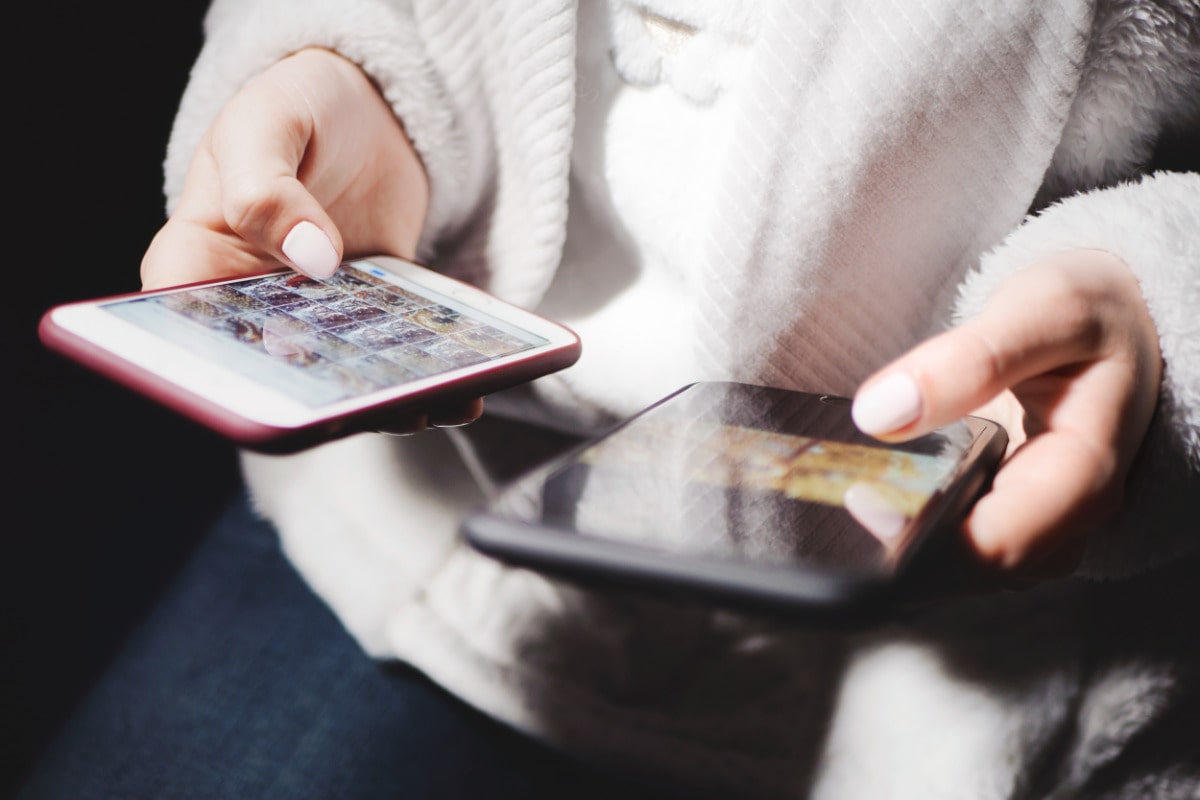
I often travel with two smartphones when I’m living abroad for an extended period of time. I used to think it was a waste, but actually, there are many benefits to doing this. Let me explain why I feel two smartphones can benefit even minimalistic digital nomads.
Here’s an interesting first-world problem: how many phones should I travel with? You might ask why I might need more than one phone. It’s a valid question. Swapping a SIM is easy and if you travel in the European Union, you don’t even need to change your SIM card.
But I’ve found a number of reasons for traveling with a second phone, in particular, a second smartphone. It’s made travel easier and I think there are benefits (as well as minor downsides) for digital nomads
The Benefits
There are more pros than cons.
1. Hotspot
You can use the second phone as a hotspot. Many cafes don’t offer internet access. For some, it’s a policy of no phones. One of the reasons is that people tend to not linger as long in a cafe. And they might be forced to even talk with each other rather than stare at their phones. For others, it’s because they’re behind the times.
If you find yourself in a cafe without wifi or a hotel with crappy internet speed (common), you can always use your secondary phone as a hotspot. You’ll still have your main phone for browsing, taking calls, etc.
2. Separation of admin and business
You can receive access codes, authentication messages, and other important communications on your main phone while using the second smartphone for travel and in-country admin and business.
3. 2nd Alarm
It can act as a backup alarm or notification device.
I’ve (almost) missed flights and had to pay really expensive taxi fares because my phone ran out of battery, I didn’t set the alarm properly, or the ring volume was too low. Having another phone set with an alarm for the same time or a few minutes on either side, is perfect as a backup in case something goes wrong. Missing a flight can be one of the most expensive mistakes while on the road so I try my best to not let that happen.
4. Backups
The other phone can act as an instant backup. Just dropped your cellphone off a cliff when taking that travel photo selfie? Well, not only is that seriously inconvenient, but it can be even more of a pain to get a new one. Remote parts of Kazakhstan or Borneo might not have cellphone stores with the model you want or need. You might have to spend money on some second-rate device that you dump as soon as you can.
The backup phone gets you online as soon as you get a new SIM card, which you probably have already if you’re following my plan.
5. Keep work and business separate
For remote workers and people that like to keep their business and their personal life separate, a second phone can make issues of security and distractions much easier to manage.
One phone for socializing, sending personal emails, booking flights, Tinder, Facebook, etc.
One phone for connecting to the corporate network or logging on to your server, purchasing online with the company credit card, and receding business-related emails.
By keeping the “work” phone as secure as possible, there’s less chance of being hacked or having some malicious software take it over. The personal phone, while just as important, can be used for entertainment and if it does get compromised, it’s less likely to affect your job or your business.
6. A second phone for work tasks
I do marketing and SEO for clients all over the world. Many of these clients are local businesses. Using Virtual Private Network (VPN) software on my second phone, I can simulate a search in the local area. Then I can see exactly what the search results look like as if I was a local searching for local businesses on a mobile phone.
7. Extra battery power
Power running down on one phone? Turn it off and use the other.
8. Use the best of two worlds
This is really only suitable for people with money to splash on two expensive smartphones.
If you want one phone for taking amazing photos (let’s say the iPhone) but another phone for its ability to load certain software (let’s say the Google Pixel), then you can switch between the two depending on your needs.
I use an old iPhone as my secondary phone. It’s tiny, which is an advantage, and works very well. The camera is rubbish (compared to what’s available today) but I don’t need it for that.
The downsides
There’s really only one downside and that’s the weight. If you’re a one-bag traveler, this fact is even more important. If you check-in luggage, it’s less important. Smartphones typically weigh around 180g (that’s the average weight these days) and that might not seem like much, but it’s almost 1/5th of a kilo. And every addition to your bag counts.
And don’t forget the charger, cable, and case. Yep, it all adds up.
Alternative to having to phones?
One way to enjoy the flexibility of two phone numbers and plans on a single device is by using a dual SIM phone. These have become increasingly popular, and most flagship models now support dual SIM functionality. However, relying solely on a physical dual SIM setup doesn’t cover all scenarios—especially for international travelers.
Another solution is to use eSIM technology from services like Saily, Airalo, or Holafly.
With the iPhone 16 Pro and a compatible cellular plan, you can use two active eSIMs simultaneously. Unlike earlier models that supported one physical SIM and one eSIM, Apple has moved towards an eSIM-only approach in some regions, such as the U.S. However, versions sold in other markets may still include a physical SIM slot alongside eSIM support.
Even older models like the iPhone 11 Pro Max support eSIM functionality, allowing you to use one physical SIM and one eSIM. This means you can switch between plans without needing a physical SIM card—ideal for travelers or those managing multiple numbers.
For Google Pixel users, eSIM support is also well-established. The Pixel 9 series allows users to run both an eSIM and a physical SIM, or even switch between multiple eSIM profiles. While previous generations, such as the Pixel 3, introduced dual SIM options, the newer models provide a more refined and flexible eSIM experience.
One of the biggest advantages of eSIM technology is the ability to buy and download eSIMs instantly, making it incredibly easy to set up local service provider plans in different countries without swapping physical cards. Services like Saily eSIM by NordVPN further enhance this experience, offering secure, region-specific data plans that can be activated within minutes.
Should you travel with two phones?
It comes down to your style of travel. If I’m traveling exclusively in Europe or only one country or zone where one phone company have coverage, I generally leave the 2nd phone behind. If I travel across multiple zones (including outside of Europe) and am on the road for a long time, the 2nd phone comes in very handy.